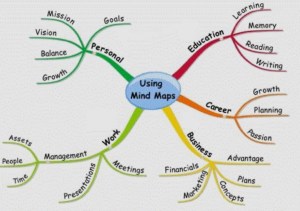
As you can see or might already be aware, Mind Mapping is a visual way to depict the components comprising a general content area.
In the context of a magic club, you might have blank 3M flip chart pages hung on the walls around the room spaced as far apart as possible with one for each of the table teams at your meeting.
You might consider hanging them with painters’ tape in landscape orientation. Usually that better serves the nature of mind mapping.
You explain briefly how to mind map by possibly even showing or drawing a re-creation of some of the image used with this post.
Now each table team is going to build their own mind map on one of the posters hanging around the room – using the scented markers of their choice from the box on the center of their table.
Let’s say the topic for that section of your meeting is “A Truly Great Magic Show.” That would go into the center circle of the mind map with branches and sub-branches coming off from that.
Before going to the wall, each person is asked to create their own mind map on the topic using a piece of paper from the center of their table.*
After completing their individual mind maps, the table leader leads his/her table team to the wall and combines their individual mind maps into one on their poster.
Upon completion, the teams rotate the room visiting other team’s mind maps until they come back to their own – adding any pieces to their own mind map from what they saw on other mind maps – helping make theirs more complete.
You’ve tapped into the knowledge of your club members as they taught each other from their own experiences without anyone having to lecture. People tend to value their own data more than that of another.
*This step is important in this (as well as other activities of a similar nature) due to the fact that members process information at different speeds. If you sent them to the wall without this step your faster processors might dominate the others to where the others’ ideas wouldn’t be heard due to the fact that they were still processing their answer.
Categories: Meeting Activities, Uncategorized
 Magic Club Leadership Resources