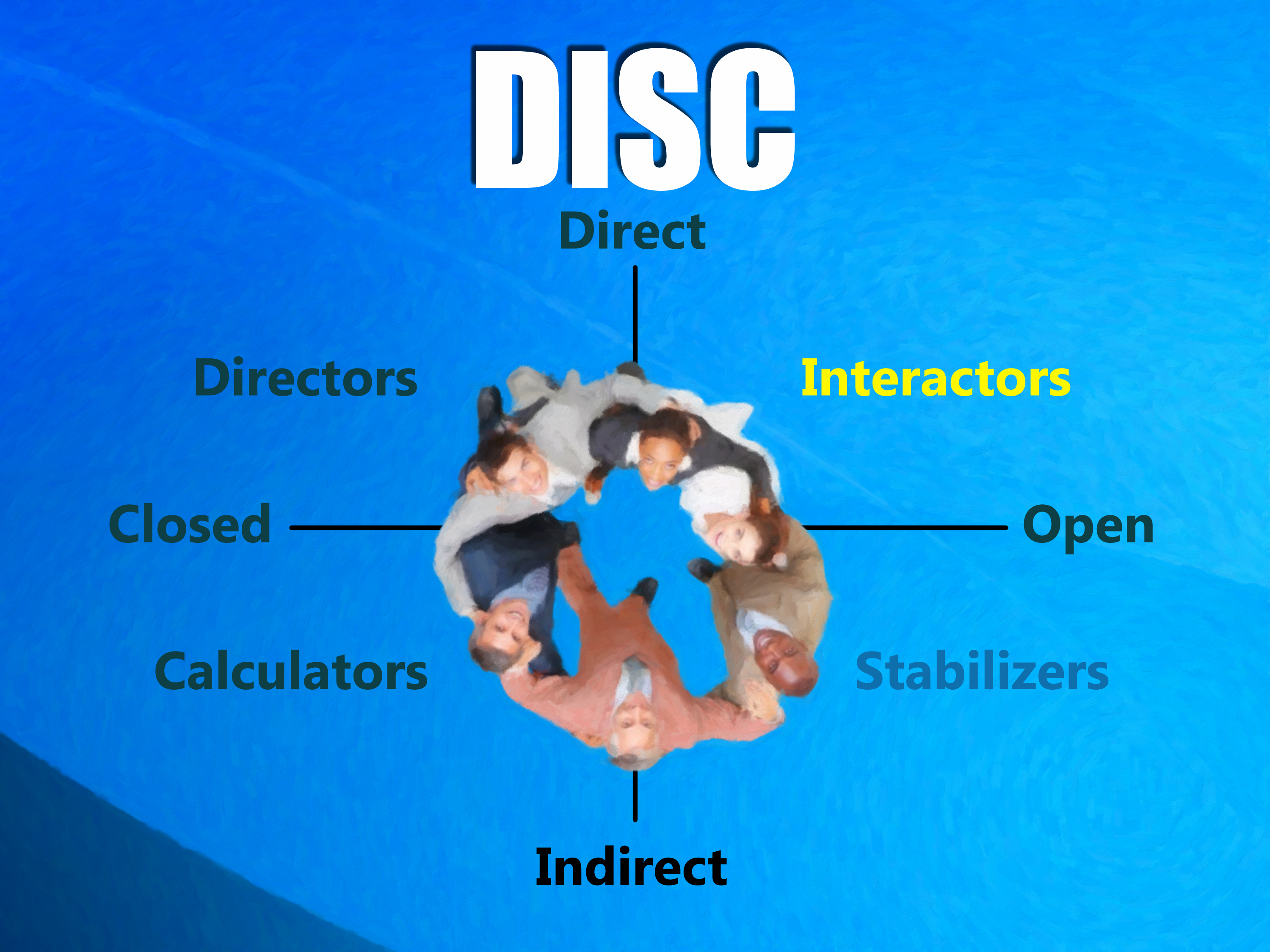
At some point early in our lives we each went over to a window and looked at the world – realizing that the world is a place where one could get seriously hurt not just physically but emotionally as well.
Each of us selected a way to protect ourselves from getting hurt, and those compose the four basic personality types. We use the letters DISC to help us remember all four.
Director personality types decided that the people who get hurt are the people who allow others to make decisions for them. Therefore, Directors decided that they would always seek to remain in control – making their own decisions for themselves and for other where required. You will see from the graphic that they are in the upper left hand quadrant of the axis – comfortable with directness but not comfortable with an openness about their family or personal matters.
Interactor personalities went to the same window but came to a different conclusion. They saw people getting hurt when other people didn’t like them. At that moment, they decided that they would keep people liking them to avoid being hurt. You’ll see them in the upper right hand quadrant in the diagram both comfortable being direct in their communications and open in their sharing of information about themselves. Compared to the Director personalities who are primarily “task persons,” Interactors are “people persons.”
Stabilizers left that window saying to themselves, “Slow and steady wins the race. The people who get hurt are the people who pull the trigger on a decision without thoroughly processing the ramifications.” They prefer to talk about the weather first prior to getting into the meat of the discussion (indirect). However, they are open to visit about their personal life too. You’ll see them in the lower right hand quadrant of our diagram.
Calculators left the window saying, “The devil is in the details.” They notices that people most often get into trouble when they don’t pay attention to details – crossing the t’s and dotting their i’s. At that moment they decided that they would always check the fine print before proceeding. They live in the details.
Fortunately, although most of us are primarily of one personality type, no one is only one. However, when someone is under stress, s/he tens to move to a different personality type during that period of time.
If you’ve ever sat across from someone who talked LOUDER or softer or FASTER or slower than that with which you were comfortable, you know that you were just happy when the interchange was over.
In the same manner, with these personality types engaging them in the style most comfortable for them is essential for building maximum bonding and rapport.
It’s not unlike an adaptation of “The Golden Rule.” Instead of “Do unto others as you would have them do unto you,” it’s “Do unto others as they would have you do unto them.”
Tip: Fortunately there is a short cut. If you match the other person’s volume and rate of speech, you will connect to their style more often than not.
Categories: Communications, Empathy, Influence, Presentation Style, Sociability
 Magic Club Leadership Resources