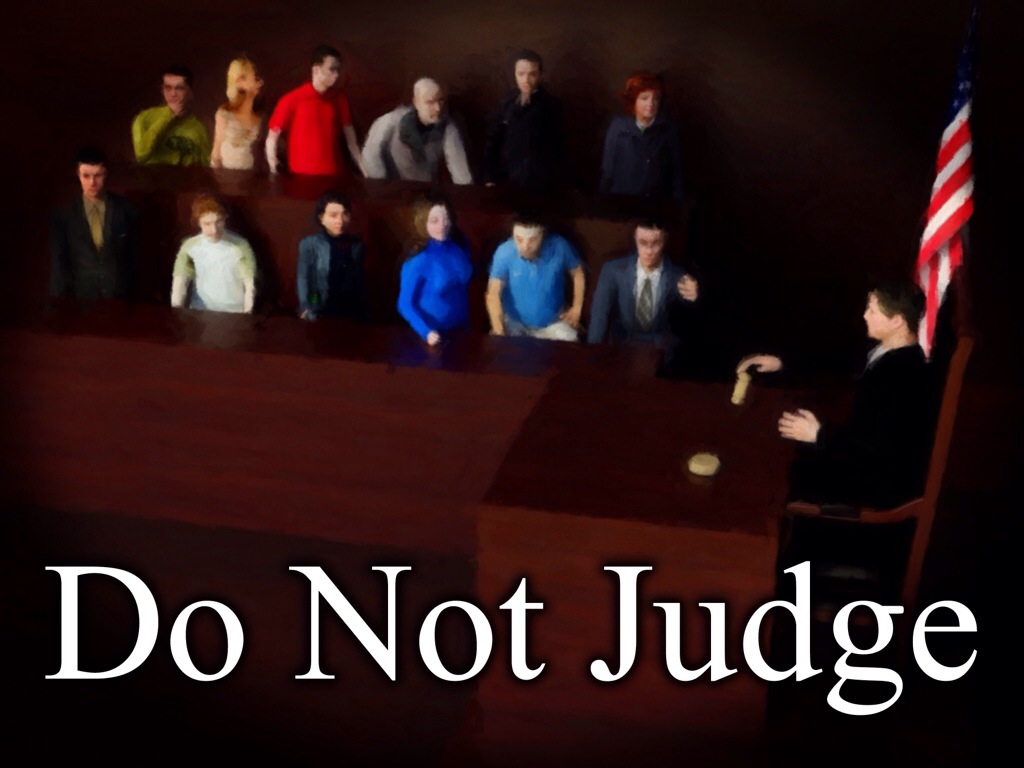
A leader is careful with the admonition “Do Not Judge” realizing that too many times it can be used to excuse clearly non-productive (wrong) behaviors. The leader understands that the phrase “Do Not Judge” is certainly not a call for the leader to exercise no discernment over the matters s/he faces.
Maybe it would be better understood in the context of another phrase that reflects negatively when it is said of anyone. “He served as both judge and jury in that matter.” Maybe that’s what we’re being cautioned not to do by the phrase “Do Not Judge.”
Serving as a jury is to determine the right or wrong of a given behavior. The jury is called to bring discernment to the situation. However, the judge is called upon to determine the sentence.
It is my responsibility to call some behavior right or wrong or evil or good. However, I believe I don’t understand enough about any person’s situation to play the role of judge – exacting the sentence they deserve for their behaviors.
Of course this philosophical discussion in no way negates the fact that the leader might need to terminate an individual for his/her behaviors. In this poster, we’re speaking of a more long-standing attitude of condemnation towards that individual which indeed can be a sentence in itself or another common sentence might be the spreading of malicious information about the individual.
The wise leader knows where the line falls between the role of the jury and the role of judge and stands firmly on the jury side.
Categories: Empathy
 Magic Club Leadership Resources