If you would more often avoid difficult conversations than have them, you might find the book Difficult Conversations by Douglas Stone to be of help for you.
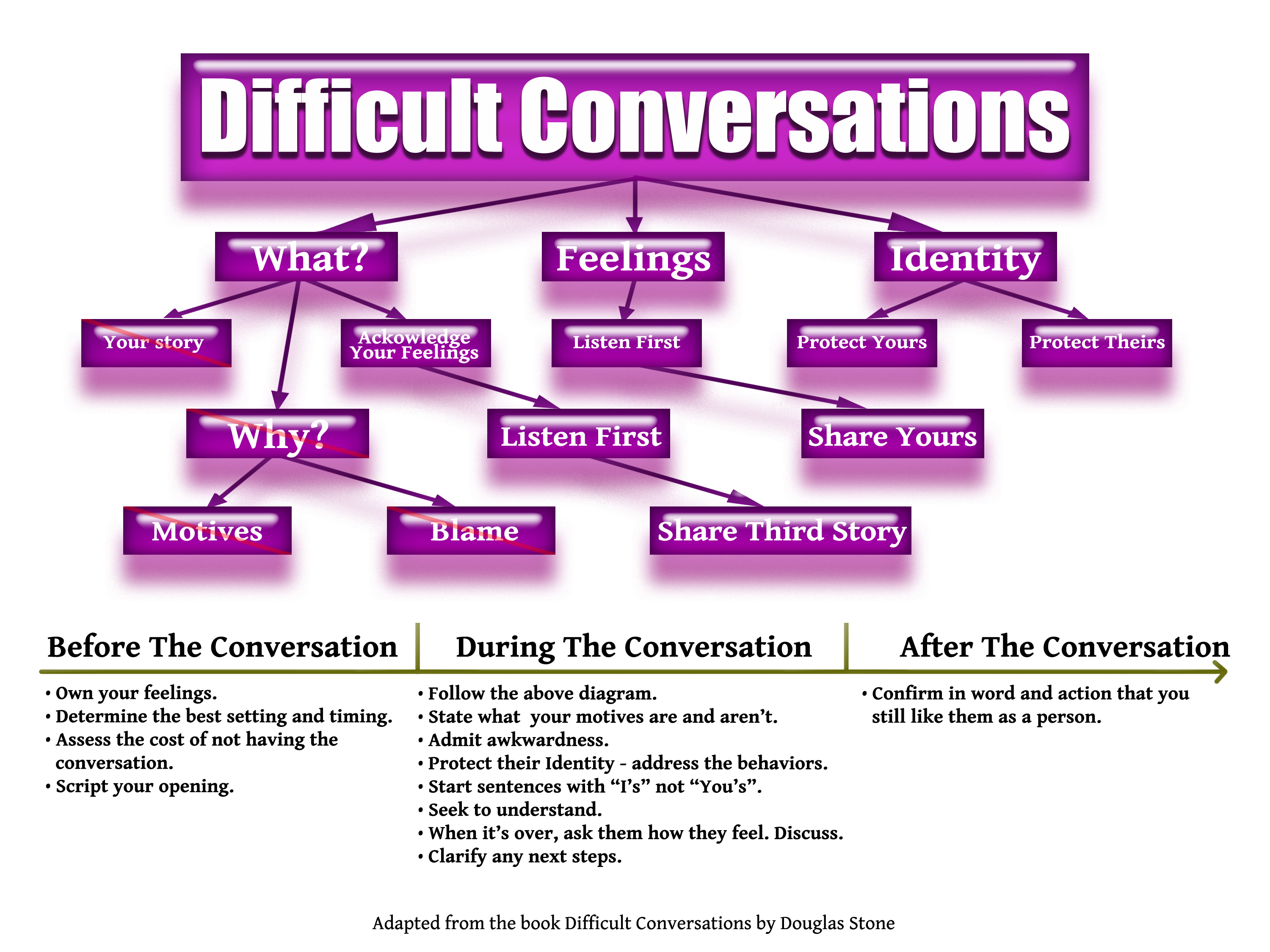
I’ve diagrammed its main thesis here on this poster. He says, in essence, that when having a difficult conversation you’re really having three conversations. Eliminating any of those three conversations will cause the conversation not ever to have resolution.
There’s a “What Conversation”, there’s a “Feelings Conversation” and there’s an “Identity Conversation.”.
Let’s imagine that something has occurred, and you need to have a harsh conversation with one of your co-workers. “What” tends to be where we start, “What happened?”
As you’ll see in the poster, make sure you stay with the “what happened” and don’t go to the “why did it happen?”
Going to the “why” causes us to dig around and try to figure out each other’s motives or to assign blame. They don’t move us forward. So, in his book Difficult Conversation,s Douglas Stone says, “Stay away from the ‘why’.”
I couldn’t agree more, and your experience probably tells you, “That’s good advice!” So, what are you going to start with?
Well before you even start the conversation, you’ll see at the bottom, “Own your own feelings.” When you go in, if you try to pretend like you’re not hurt (but you are hurt) that’s going to emerge at some point in the conversation. If you try to pretend like you’re not angry (but are angry) it’s also going to negatively impact the conversation.
Own your feelings about the situation. This will help you determine the best setting and timing. Catching the other party off-guard in the hall might not be the best.
Assess the cost of not having the conversation. Is this a conversation that really needs to be held? If it’s not (i.e. if the cost of not having it is not high) it might be one that you’d want to avoid.
Script your opening. The opening is the hardest. Script your opening. Don’t be afraid in your opening to say, “This is very difficult for me, but I believe I want to have this for the sake of our relationship.” Don’t be afraid to talk about your nervousness — you’re awkwardness. And then, just go ahead and have the conversation.
When the poster says, “Acknowledge your feelings,” it means that you acknowledge your feelings to yourself. If you’re hurt, admit that to yourself. If you’re frustrated admit that to yourself. You might need to wait until that emotion has a chance to die down before beginning that conversation. If you don’t acknowledge your feelings to yourself, that emotion has great potential of sabotaging your difficult conversation.
Listen first.
You’ll ask them, “What happened in your situation? What did you see happening?” Seek to look through their eyes at the situation.
Do not share your story. You can see that coming off of the “what diagram” there.
Don’t share your story. Instead, share what the author calls “The Third Story.” That would be the story which would be shared if you had a third party negotiating.
In other words, you would share — “So, if I heard you correctly, then what you’re saying is — and from my perspective, it looks like this. So, where our impasse might be is here.”
Isn’t that what a negotiator would do?
You already know your story, so you don’t have to share your story. You just have to hear their story, blend it with your story and speak as though you were negotiating between the two parties.
We get through the “what” pretty easily and then we say, “Okay, I guess we got that ironed out”, and we leave. But there are feelings that have to be dealt with.
What happens if we don’t conduct the feelings conversation is we find ourselves not resolving the situation. Instead, what happens is it bubbles up again. Sometimes in days, sometimes in weeks, sometimes in months, but the feelings were never resolved about the situation.
Dealing with feelings is key.
During The Conversation the poster reminds us to state what our motives are and are not. I’ll declare my motive (i.e. “I’m not trying to be hurtful here. I’m really trying to not hurt our relationship.”) so the other person doesn’t have to venture a guess as to our motives. All too often when I try to guess at another’s motive, I go to the negative side in my assessment.
Admit your awkwardness — protect their identity. You’re addressing behaviours, not whether their worthy of ever being loved again. Start sentences with “I’s” not “You’s”.
Seek to understand.
In the second conversation you’ll be sharing your feelings with the other person. After hearing their feelings, you’ll start out by saying, “I feel this,” or, “I feel that.” Make sure that whenever you do share your feelings, you actually do share your feelings. However, stating “I feel like you’re wrong” is not sharing your feelings. It is merely sharing your opinion of their behavior masquerading as a feeling. As we said earlier, “I feel hurt” or “I feel frustrated” is more of a true sharing of your feelings about the matter under discussion.
In the statement “I feel that you’re wrong,” you’re certainly using the word “feeling,” but it’s not a feeling. “I feel hurt. I feel sad. I feel discouraged.” Those are feelings.
“I feel that you did this.” That’s not a feeling. This lack of understanding can derail the conversation right at this point.
When it’s over, ask them how they feel — discuss, clarify any next steps. That’s all. Alot of it’s part of the feelings.
You’re going to listen to their feelings — first one, “How do you feel when this happened?”
All of us have identities and roles, and I encourage you to go to that particular poster in this leaderhship poster set and take a look at that.
We all have identities. That’s who we are apart from our roles. Our value as a human being, our worth as a person.
Our Identity is truly about our feeling of worthiness to be loved (or not).
The Third Conversation says to “Protect yours and protect theirs.”
Let them know that you’re speaking to the role’s side. You’re not speaking to their identity. You’re speaking to the problems, not them as a person.
Protect theirs.
If you protect theirs, they won’t have to protect theirs. If they know that you’re not going to go after them personally for what occurred, they can drop their guard and speak candidly with you.
After the conversation, confirm in word and action that you still like them as a person. Take some time to reaffirm them.
As we said, ask when it’s over, “How do you feel?” Discuss how they feel. “Did they come through the conversation okay?” And then, as time goes on, confirm that you’re still okay with them.
It was a harsh conversation, it was a difficult conversation, but you’re still okay with them as a person. It did not get personal. It only spoke to events that had occurred. My hope is that this plan helps you to fill in the details and connect the dots more closely. It could be that the book Difficult Conversations by Douglas Stone might point you in the right direction.
Categories: Conflict Management
 Magic Club Leadership Resources