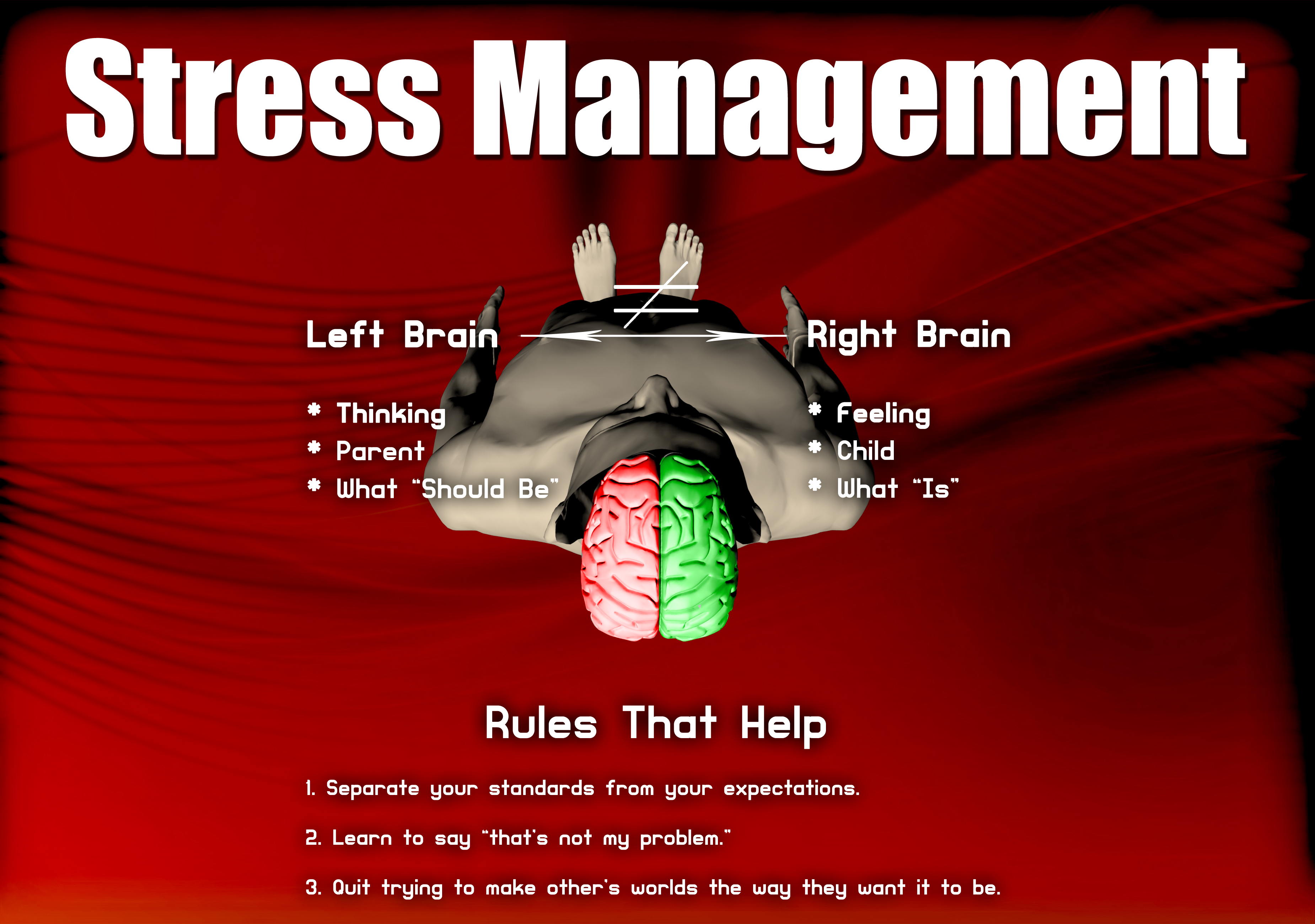
As you look at the stress management poster, you’ll see a downward shot on the person’s head – showing the right brain and the left brain. Those that study this far more than I do tell me that the right brain is where our feelings/emotions exist. The left side is where our thinking/logic exists.
And it’s as those two come into conflict that we feel stress. The left brain, (that logical part of us), the parent inside of us, talks to us in terms of what “should be.” The right side of the brain, the child part of us talks in terms of “what is.”
I often wouldn’t take my children out in public or at least was squeamish about it because they were so honest until they learned what should be. We’d be standing, talking to somebody and suddenly they’d say, “That person has bad breath.” And the person was still there! I would have to take them aside and say, “We don’t do that. You shouldn’t have said that while the person was still there.” The left brain came in. The child was so honest.
When my left brain and my right brain are in agreement, I don’t have stress. When my left brain and my right brain are supporting each other, there is no stress.
This morning, I stood in front of a mirror. I looked at myself. I said, “You have a fairly large nose.” Fortunately, this morning, the parent came in and said, “You should have a large nose. Your grandmother had a large nose. Your mother had a large nose. It runs in your family (no pun intended). It makes sense that you would have a fairly large nose.”
Okay, I was at peace. Had the parent weighed in with, “you shouldn’t have a large nose,” I would have begun to stress. Think about those situations in life in which you experience stress. It will have something to do with what is not equalling what should be.
I stand in a line of traffic. A car has passed at the speed of light. Clearly, the sign says, “You’re going to have to merge.” Yet they continue to not merge. My internal parent screams inside, “They shouldn’t do that.”
What is is not equaling what should be, and I start feeling stress. I have a moment of irritation over that event. What is isn’t what should be.
This is all good news. It’s good news because stress is not some force outside of ourselves. It’s not a great cloud that suddenly comes over us and settles down on us and we suddenly feel stress..
Between every situation and every feeling of stress, there’s a thought. If I was carrying dishes from the table, and I dropped one and it broke on the floor, and I felt stressed; it wasn’t the breaking dish that caused me to feel stress. It was my thought about the breaking dish that caused me to feel stress. Maybe, I said to myself, “You shouldn’t have done that.” “What’s the matter with you?” “You’re stupid.” “You’re clumsy.”
That conversation might have started automatically, but then I felt stress. When I broke the dish, I thought to myself, “I shouldn’t have done that.” Stress is when what is does not equal what I believe should be. The good news is if I can capture that thought, and I can think it through; then I can actually dismantle, reverse-engineer my stress.
Three rules that I have found help immensely and make this very practical.
Number 1 is to separate your standards from your expectations. If you want to manage your stress, your standards cannot equal your expectations. What do I expect from my children? What are my standards for my children? My standards are pretty simple. My children should not lie to me; (that’s the left side of my brain).
My children should not lie to me. I’ve made that clear to them.
What are my expectations for my children? My children are going to lie to me. If my standards and my expectations have never been separated, that produces stress.
Standards come from some external source from which I pull my values and morals. And I say, “Here are the standards.” And I’m going to try and not deviate from those standards. You don’t have to deviate from your standards. But my expectations come from getting to know another person and reasonably setting expectations for that person in the light of who that person has proven themselves to be.
I don’t have the same expectations for some people due to the capacity that they have for growing, or for skill development, or their background, as I have for other people. My expectations vary person to person. My standards do not vary. Stress is produced when I don’t have a clear separation of my standards from my expectations.
Number 2 is to learn to say, “That’s not my problem.” I don’t mean that in a cavalier manner. And I don’t mean in a way that would cause you to act like you don’t care. But understand what is your problem and what isn’t your problem. When I take on problems that aren’t mine, and I try to solve problems for other people, I am operating outside of the “room of reality.”
Reality is, “You have problems, and I have problems.” Reality in physical terms, is “I have a yard, and you have a yard.” There’s a lot line. I keep my yard mowed, and you keep your yard mowed. I can offer you help if you happen to be sick, but it’s your responsibility to keep your yard mowed. It’s your problem to keep your yard mowed.
Know what your problems are, and what belongs to another. There are many people who would want you to have the monkey on your back (which only increases your stress).
Number 3 is to quit trying to make others’ worlds the way they want it to be. There is a “room of reality.” Reality is this: sometimes I win, sometimes I lose; sometimes I make good decisions, sometimes I make bad decisions; sometimes I make money, sometimes I lose money. This is reality.
Many people like to live outside the room of reality and they want you to help them live outside the room of reality. And when you don’t help them (psychologists would call it “enabling them”), they are going to be irritated with you. However, stop and think of what an irritation is.
An irritation could be something as simple as “I’m not meeting the expectations of another.” Does it mean that their expectations are reasonable? It doesn’t even mean their expectations are functional. Those expectations can be very dysfunctional. They could be looking at you saying, “Here, I need this done by tomorrow at noon” – turning and walking away.
They want their world to work so that no matter when they gave it to you, no matter how much they gave to you, they want you to make it so their world can get it done at noon tomorrow.
Maybe it’s reasonable. Maybe it’s not reasonable. Quit trying to make other people’s worlds the way they want it to be – altering reality. If I could, I would. I just don’t have that much power to alter reality.
We struggle as we go through this. We understand as people that as you draw these boundaries, and start to speak reality to people (when they want you to speak in ways that help them make their world the way they want it to be) there’s going to be friction. They’re going to go through the stages of grief as the lose something they want. There is going to be denial, bargaining, anger, depression, acceptance of the fact that you’re holding the line on the way things really work.
Don’t give up as they go through those various patterns. The way we say it is this, “We teach others how to treat us.” If you don’t like the way you’re being treated by somebody, you taught them to treat you that way and you can teach them differently.
Re-train them. It will take time. It will take persistence. It will take consistency on your part to get the job done. But you’ll watch your stress come down as you do.
 Magic Club Leadership Resources
Leave a comment