As we saw in another poster, there is no 100% proof that someone won’t let us down as we lean on them within the context of a relationship. Consequently, when trust is broken, the truly great leader understands the necessity and the actions needed to rebuild that trust.
To be sure that rebuilding will take time. As we saw in the initial Trust poster (in the Introduction), it will take time to reconfirm one’s consistency, competency, intimacy, and selflessness.
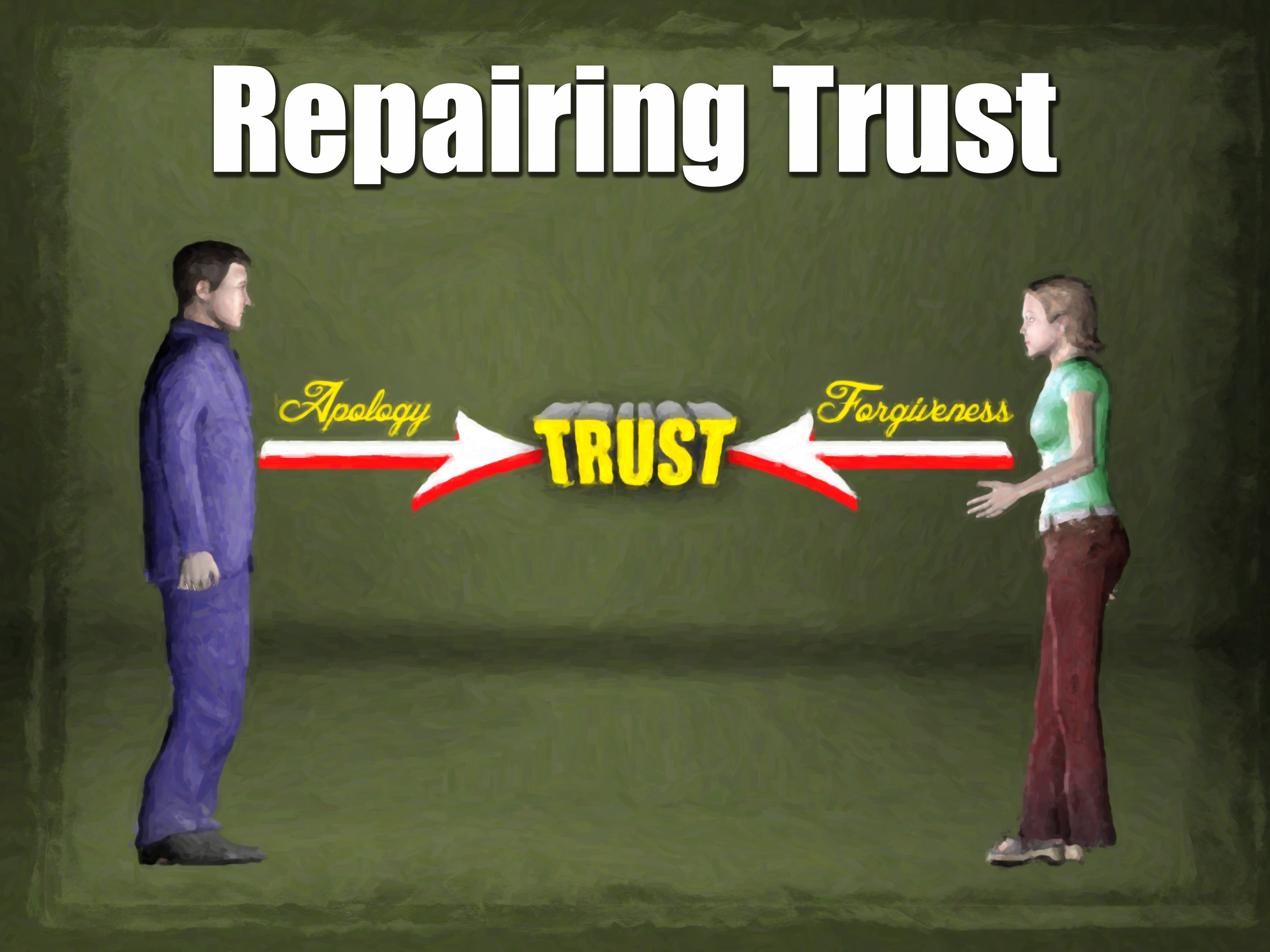
However, the starting point can be seen in this poster, and it’s a two-person job.
An apology needs to be forthcoming from the offender. This is at its most basic level an admission of personal responsibility for the offense. Consequently, the apology (in order to truly be effective) can have none of the sounds of “Although Bob did so too, I’m sorry that I went along.” It must be the offender standing in front of the offended all alone speaking only to what the offender did (with no excuses).
As we can sometimes hear from our children as they learn to speak apologies, it can have no hint of “I’m sorry I was caught.” In order for an apology to be effective, it has to speak as specifically as possible to the offending action or attitude. “I’m sorry I hurt you” won’t be sufficient.
An apology cannot be a veiled attack on the other person not having thick enough skin (i.e. “I’m sorry that you got hurt by what I said.”).
It must speak directly to the offense in specific terms – taking full responsibility for your own actions. “I’m sorry that I lost my temper in the meeting – attacking you like I did” would be an example of an effective apology.
Now whether the other person responds with forgiveness or not is out of your control. You will have done your part in trying to repari the trust. S/he will now need to decide whether or not they wish to do theirs.
As it was said earlier, none of this negates the fact that it will take time to rebuild the trust. This poster is only the beginning.
Here’s probably the best news of all. You don’t need to wait for someone to apologize before you forgive them! In fact it’s in your best interest to do so, since bitterness saps even more of your finite amount of energy from you – energy that could be more profitably applied to other projects.
When do I have the most trouble forgiving someone else apart from them presenting to me an apology? It is when I forget how many times I’ve had to receive forgiveness for my own offenses. Those days when I underestimate my own capabilities of offending, I will find it hard to forgive another. Those days when I see how much forgiveness people need to give me in order to stay in a relationship with me, it becomes easier to forgive another.
Either way . . . Apology + Forgiveness = The Beginning Of Repairing Trust
A great leader uses this formula regularly.
Categories: Conflict Management, Sociability
 Magic Club Leadership Resources