As we begin the exploring of how to make wise decisions, I want you to imagine for a moment that you’re in a restaurant. Out of the corner of your eye you see your best friend’s spouse. But your best friend’s spouse is not sitting with your best friend.
You think nothing of it; you put your head down; and they don’t see you. You keep eating – trying to mind your own business. Suddenly, you see they reach over and touch each other’s hands. But it could still be business. You’re not going to draw conclusions from this.
So, you keep eating, but you watch out of the corner of your eye as they get up to leave. As they leave, they go out through the front door and pause in front of the big plate glass window, “Please, no, no, no,” you say to yourself as they kiss before each goes in their separate cars.
You replay that kiss. It is not a brother-sister kiss. It is a romantic kiss. You are thinking, “Now I have a decision to make. Do I tell my best friend what I’ve seen in relation to his spouse, or do I not?”
Those who study this decision-making process way more than I do – and by the way, this information comes from a book, Discover Your Blind Spots by Dr. Bob Smith – indicate to us that when we go to make a decision, we have up to six different thinking centers that we can draw from. Most of us operate our life on two or three of these at most.
Think about the restaurant scenario we just imagined. Would you tell your best friend or not? And why? If I was there, I would ask you to tell me what caused you to make the decision you made because in telling me that you’ll be telling me which of the thinking centers you relied on most heavily and which you ignored.
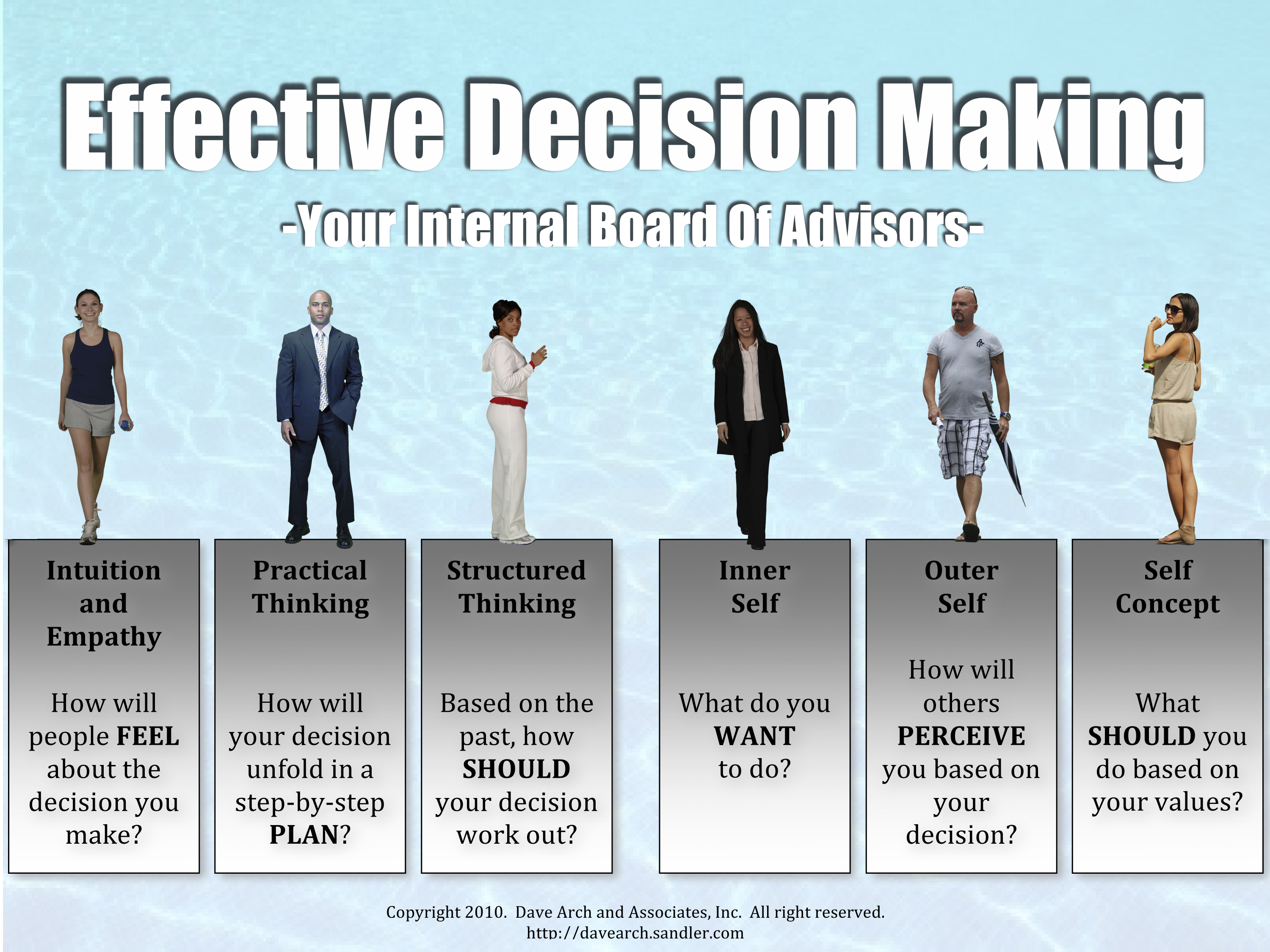
Here are the six from left to right.
Intuition and Empathy – how will people feel about the decision you make. Did you consider the feelings of your best friend? Did you consider the feelings of your best friend’s spouse? Did you consider your own feelings? Were feelings a big part of your equation or not so much?
Practical Thinking – how will this work out practically? If I tell my best friend, and then others find out, and then they . . . Step by step you would play it out. Did you do that at all? If you did, that comes from the Practical Thinking center.
Structured Thinking – here you drew on past experience. Maybe you said something like. “I’d tell my best friend, he should be happy to hear it from me. I’d want to know if anyone saw my spouse doing that. He should be happy.” The words should will trip in you the fact that you’re using Structured Thinking. This thinking comes from structures that have been used in your past, and you’re extrapolating what you learned into this decision.
Inner Self – what do you want to do? Did you even stop to consider what you want to do? You might have thought “I want to hide. I want to pretend I didn’t see it.” Did that even enter into your thinking? If not, that thinking center probably plays a small role in your decisions.
Outer Self – how will others perceive you based on the decision you ultimately make? If you don’t tell, and then the spouse finds out that you knew, you might be perceived as disloyal. “Why didn’t you come to me?” the spouse might say. If you do tell, they might perceive you as a busybody, getting involved in matters that aren’t yours. How will others perceive you? Did that even come in to your thinking when you decided what you were going to do in that scenario?
Self Concept — your internal set of values and morals come into play here. What should you do based on your values? You might have said, “I’m a loyal person. As a loyal person, I believe it’s my duty to tell my best friend,” and you’d go do that.
When all six thinking centers weigh in before we pull the trigger on the decision, we will make the best decisions possible.
However, in the course of a day, if I had to let all six thinking centers weigh in, I’d still be at the closet. “What should I wear today? Let’s see. How will others feel by the shirt I put on? Let’s see. Practically speaking, how will these clothes work out in terms of the changing weather?” I’d still be at the closet. So, I can’t do that. “What route should I take to work?” I cannot take time to let all six thinking centers weigh in on every decision.
That pattern throughout my day puts me into an habitual overusing of one (or two or at the most three thinking centers). Can you figure out right now what those would be in your life based on how you decided regarding telling the spouse or not telling the spouse? Which one(s) had little or no influence over your decision?
I encourage you to draw short stick people on top of the boxes that you think you don’t depend on very much. Next draw tall stick people on the boxes where you feel like you maybe over-rely.
Here’s what we know. Those six thinking centers never totally agree with each other. Maybe that’s why we don’t like hearing from all six. The thinking centers may not even be giving us good advice.
Let’s take them one at a time.
If I don’t hear from “How will people feel about the decision I make”, that’s going to sabotage the decision later. People’s feelings tend to come like a back draft in a fire. If I haven’t adequately assessed what their feelings are going to be, I’ll find myself really caught off guard after I make the decision. “How will others feel?” is a question that might not just determine whether I do it or not, but it might determine how I do it if I’m more sensitive to others’ feelings.
Practically, how will it work out?
I may never hear from my Practical Thinking center – taking time to play it out step by step in both directions (i.e. telling my best friend or not telling my best friend). I may just go off of my “shoulds”. And then, I find myself having made an impractical decision that down the road plagues me.
If I have a loud voice coming from my Structured Thinking, that means my “shoulds” are very loud. He should be happy to hear from you because you’d be happy if someone came to you and told you. You’d want to know. Structured Thinking – how should your decision work out? If I never use this, decision-making is very, very difficult because I never build on past experiences. Every decision starts over at square one.
What do you want to do? I talk to some people who get into their mid-50s and say, “You know, it’s been so long, Dave, since I’ve asked myself what I want to do that I don’t even know what I want to do anymore.” That’s a problem because our energy comes from passion. And our passion comes from doing what we want to do. Those mid-life crises where guys (or women) get fed up and and throw off all their responsibilities. They’ve been doing what they should do, “And it’s time for me to get a little bit of action for myself.” And that’s the person who has not listened to “what do I want to do” nearly frequently enough.
Outer Self – how will others perceive you based on your decision? None of us can be known by everyone. Only our closest friends really know us. And certainly, they give us space for all kinds of behaviors, quirks, and attitudes. But beyond that couple of relational circles out, these people are only going to have a perception of us. It’s our brand. Particularly in a company, we have a brand. That brand might be based on reality; it might just be based on perception. But perception ends up being reality for the people who have the perception. I have to manage my brand. I have to manage people’s perceptions of me.
This one plays right into that last one – Self Concept. If that thinking center speaks loudly, you will say, “I’m going to do what’s morally right, and let the chips fall where they may.” In that phrase, you’re dismissing people’s perceptions of you, and that’ll come back to haunt you later. I’m not saying you shouldn’t do what’s right. I’m saying the way you do what’s right needs to be governed by the perceptions people might have of you.
It’s very, very powerful to let all six thinking centers weigh in. Now, very seldom does this actually occur within ourselves. Usually, we’re reacting, and that gives us about one or two thinking centers. Or we’re reflecting, and that maybe will give us three or four thinking centers.
But when we’re relating to others – that’s when all six tend to come in. And what might look like a disagreement when a group’s having a discussion is actually each person weighing in from those thinking centers on which they over-rely. Those thinking centers that are the loudest in their heads tend to be the ones they contribute to a group discussion, which could balance it for other people in the group.
The wisest of decisions are made when I let all six thinking centers weigh in before I pull the trigger. Again, this is based on a book by Dr. Bob Smith, Discover Your Blind Spots. The Hartman-Kinsel Assessment is the accompanying assessment that I use in my Executive Coaching to fine-tune your decision-making ability based on the centers you either overly rely on or minimize.
Contact me at my email address: dave@sandler.com for pricing information.
Categories: Assertiveness, Decisiveness, Detail Orientation
 Magic Club Leadership Resources