This poster hopes to explore the differences between “Healthy Acceptance” and “Toxic Acceptance.”
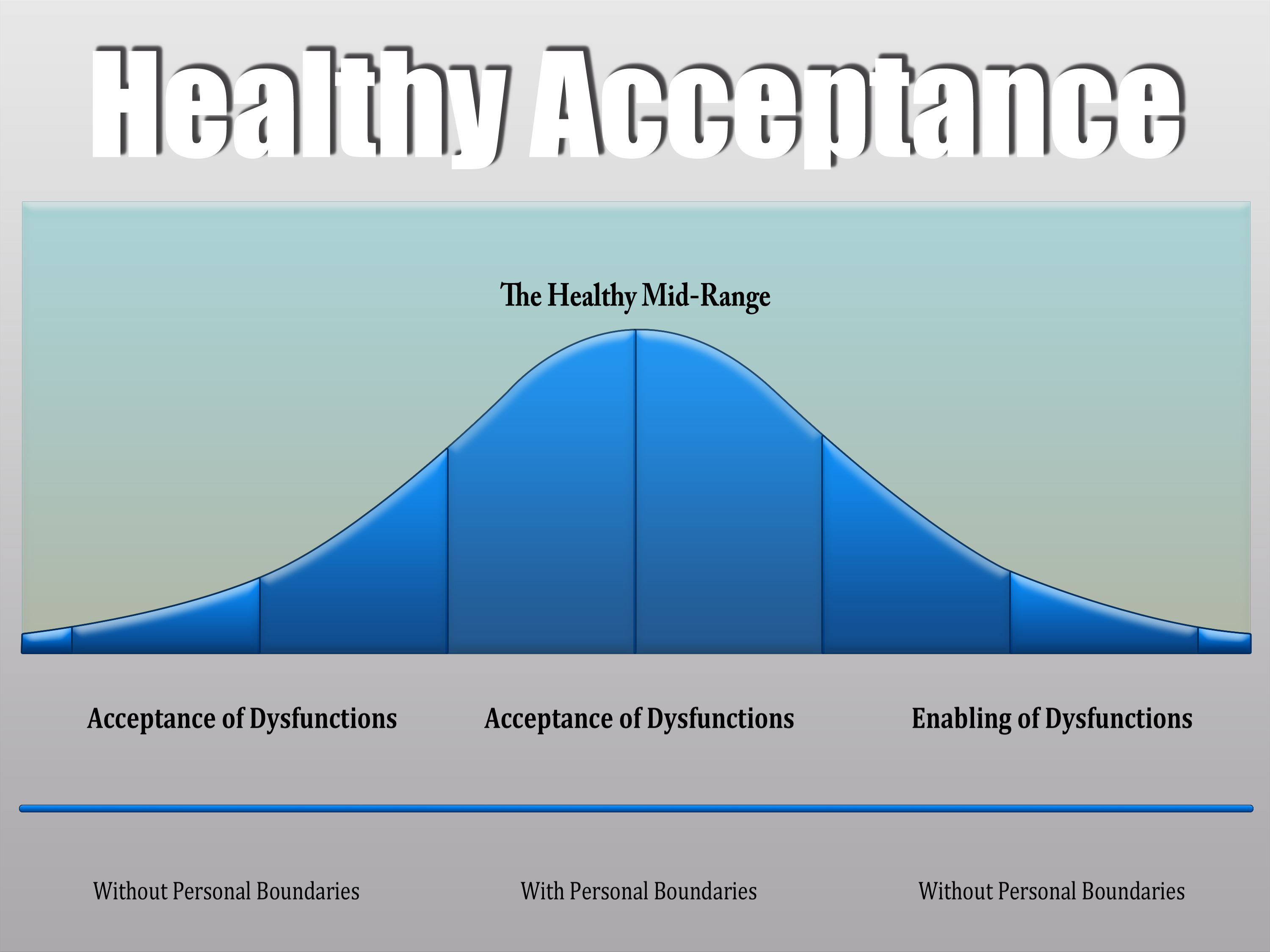
The battle cry in the workplace is “you need to accept me the way I am.” That may be true, but I believe there’s a healthy approach to acceptance, as you’ll see in this diagram.
The healthy mid-range falls right in the place where I accept people and understand that everyone has dysfunctions. The fringes of acceptance can be found at the far left end and that’s where I accept people’s dysfunctions – disregarding personal boundaries of my own.
Let’s use a bizarre dysfunction. Someone insists on spitting. It’s just a habit. They spit whereever they go. I accept that as a dysfunction. It’s a sad dysfunction that they have to spit wherever they go, but I accept that about them.
However, I have personal boundaries which say, “Please do not spit around me.”
Is everyone allowed the right to have personal boundaries? Think of it physically. You have a boundary. You don’t want someone to come up to you and be a “close talker.” You have a range of area in which you want people to stand when they’re talking to you.
And when they get too close, it’s uncomfortable. Then again, if they stand too far away, that’s uncomfortable. There are boundaries that you, as a human being, are able and authorized to set for yourself.
The far right end of this particular bell-shaped curve is where I go to actually enable the dysfunctions of others. So now, not only does this person have a problem with spitting, I enable it. I say, “Here, let me bring you a spittoon.” I encourage it.
“Healthy Acceptance” is found in the middle. It’s where I understand we all have dysfunctions, but I don’t allow you to act out your dysfunctions on me. I have personal boundaries that I put up to protect me. That’s my right as an individual. Anything else ends up being toxic.
So, all acceptance is not created equal. A leader understands that sometimes, in accepting their followers, they are doing their followers no favors. The leader accepts the fact that we are all flawed. We accept the fact that we are all imperfect.
I like the person who said, “Everyone’s crazy once you get to know them.” But that doesn’t mean that I allow you to act out your particular form of craziness on me. That’s the role of my personal boundaries. That’s where a leader finds healthy acceptance.
Categories: Empathy
 Magic Club Leadership Resources