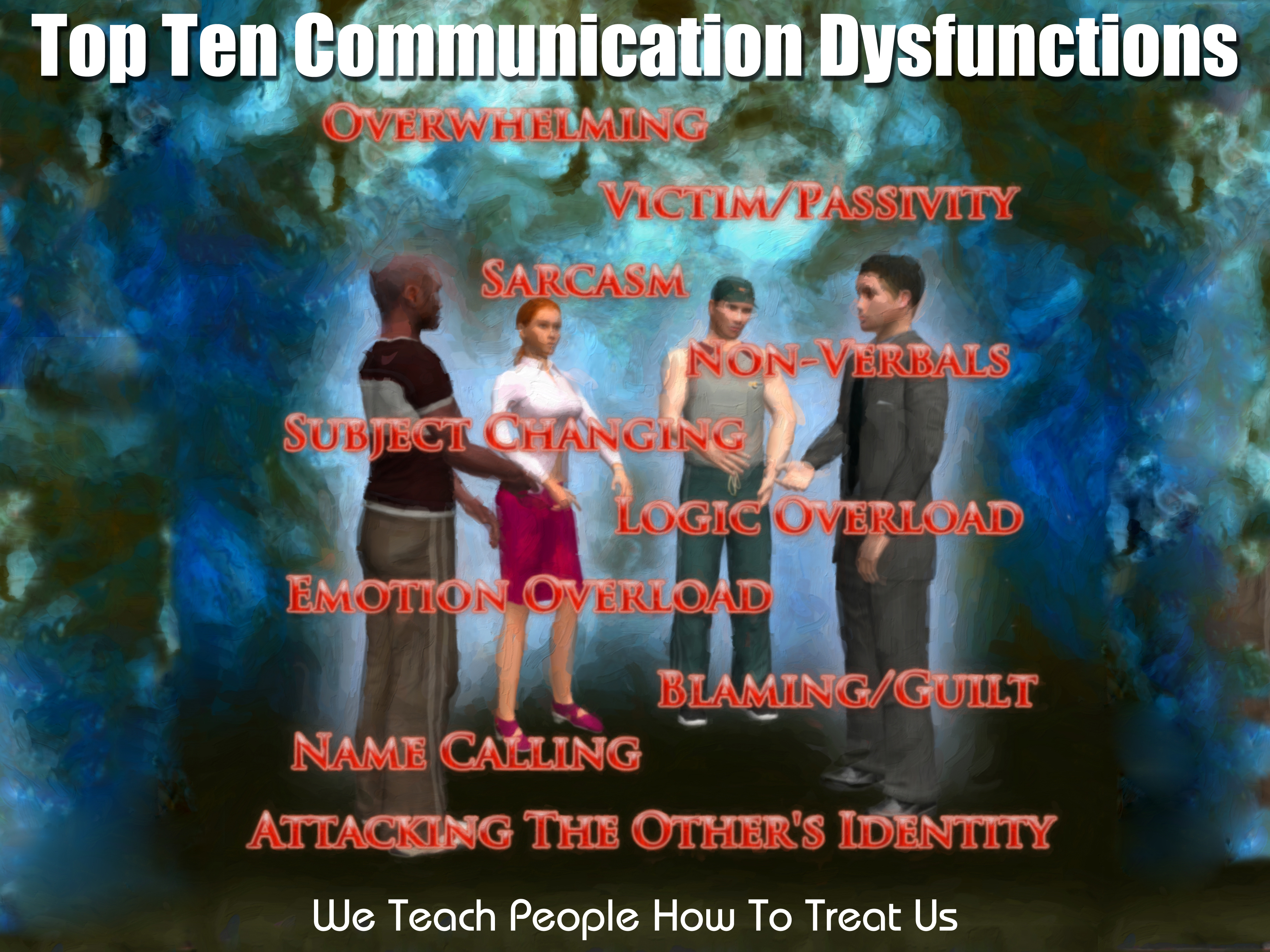
These are the most Common Communication Dysfunctions that happen in interchanges between people.
At their heart, they have one commonality. One person is using the strengths they have against the person with whom they’re talking. They’re doing this to bring that person into submission – acquiescing to their opinion or their way of thinking.
Hence, the first word on the poster is Overwhelming. If I can think faster than you, then I’m going to out-think you. If I can talk faster than you, then I’m going to out-talk you. If I can emote quicker than you, more than you, then I’m going to out-emote you. I’m going to out-logic you. You’ll see Logic Overload as part of the list, Emotion Overload as part of the list. I’m going to overwhelm you.
However, that’s not fair. Just because you can verbally or by the force of your personality cause me to submit doesn’t mean you should. That approach is dysfunctional.
Okay, so I can’t dominate you, then I’m going to pull in and just unplug from you. It’s often seen in a meeting where a person pushes his chair away from the table, crosses his arms, folds his legs, and literally turns sideways to the rest of the table. That person has unplugged. That’s not fair.
Sarcasm — “Oh, well, you could do that if you want to ruin the whole thing,” someone says. “What do you mean by that?” I respond. “I was just joking,” the person responds.
Sarcasm is particularly insidious, because it has a backdoor. You can’t be called on it, because you can always go out the backdoor of “I was just kidding.” It gets the conversation nowhere. It does not move it forward. “What did you mean by that?” is about the only response that you can ask – bringing the person to where he actually says what he meant rather than cloaking it in sarcasm.
Non-Verbals speak to the rolling of the eyes or the sigh. The only way to combat this dysfunction is by saying, “What did you mean? Now, if I’m left to myself to assume I know what you mean, I usually go ‘dark’. I would rather you tell me what you meant when you did that.”
Subject Changing is combated best before starting a conversation – having the subject of that conversation already defined. If anything comes up, you both agree to put it on hold for another conversation.
Blaming and guilt can cause so much time being spent in a conversation with no resolution of the situation ever occurring.
On the subject of Name Calling — frequently, an organization will tell me, “We don’t name call around here.” “Oh, I bet you do. You’re just sophisticated about it,” I’ll respond. You’ll say something like, “Now, the intelligent opinion to have is –” Meaning that anyone else who doesn’t have that opinion is not intelligent. That’s name calling in a sophisticated fashion.
Or you’ll say it in a certain tone of voice, “Now, don’t you understand that the best way to do this is to –” They can fill in the blank at the end. The word is “stupid.” You’ve name called.
Attacking The Other’s Identity is where we go beyond blaming and guilt, we go to shaming.
In my understanding, the difference between guilt and shame is that “guilt” is saying “You made a mistake.” Shame is saying “You are a mistake.” Powerful. With shame, we’re attacking the other’s identity. In essence saying they’re not worthy of being loved. Now that is a low blow.
We teach people how to treat us, as it says at the bottom of the poster. When people come to complain about how they’re being treated, I wait until the end of their complaining and then oftentimes say, “You taught them to treat you that way. How are you going to change that?”
And it means that they’re going to have to put up personal boundaries. Boundaries that prevent these dysfunctions from occurring in their presence. Boundaries that prevent people from using these dysfunctions against them.
A strong leader knows to stay away from these Top Ten Communication Dysfunctions and knows how to call out his or her followers when they start using them.
Bonus: Watch carefully that none of these communication dysfunctions become an accepted part of your organization’s culture. “That’s just how we do things around here” when spoken about any of these dysfunctions allows toxicity to grow in your organization – diminishing its attractiveness to new members.
Categories: Communications, Sociability
 Magic Club Leadership Resources