One of the most stressful situations in life is when one tries to make one gender like the other gender and then gets frustrated because they just aren’t the same.
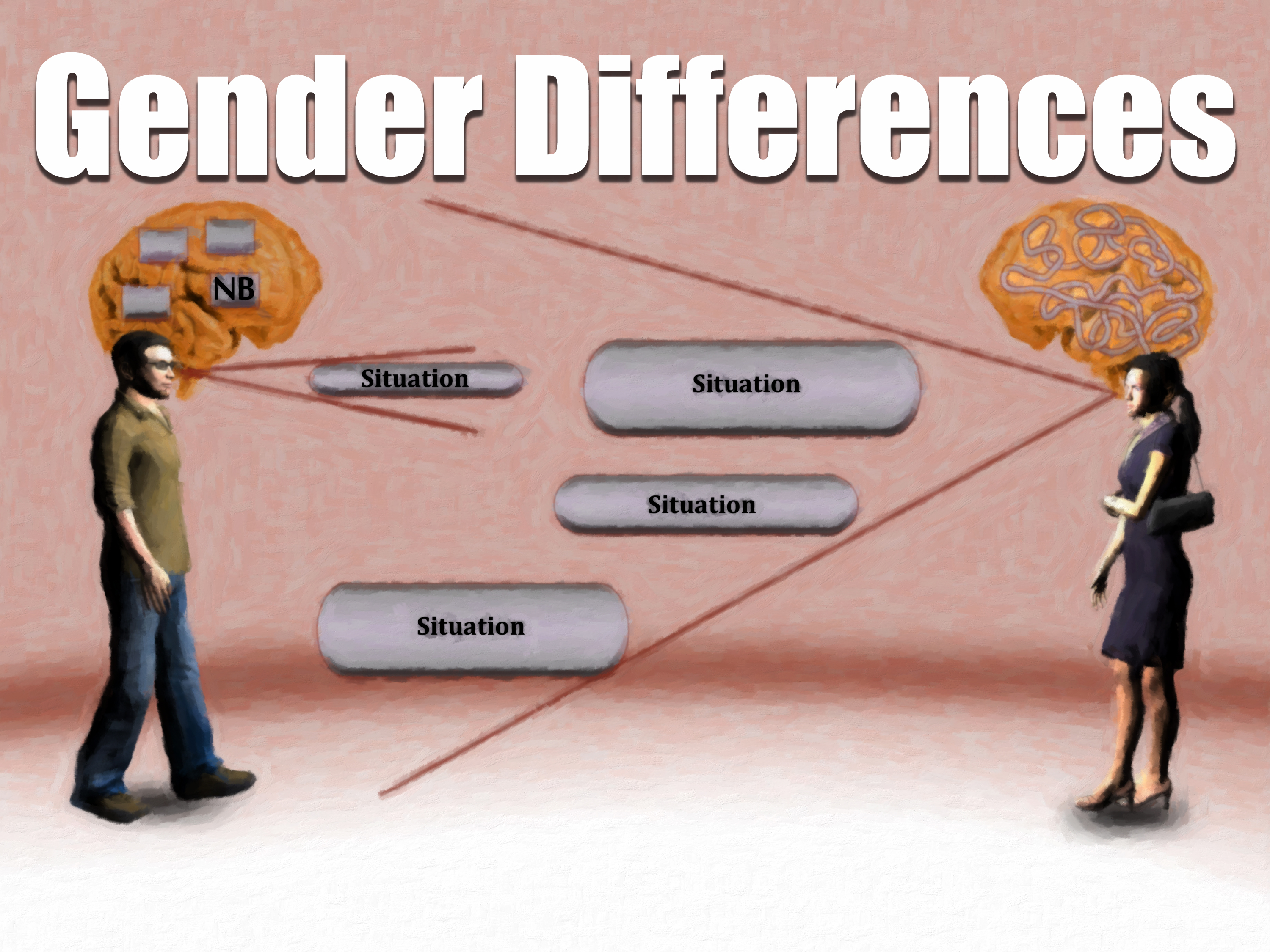
In this particular poster entitled Gender Differences I attempt to put down what I see as the main differences between the genders in terms of how we see things and how we think. I think to the extent that we can embrace the truth of this poster, it’s going to help us greatly benefit from what each gender contributes to a given situation.
Many of these insights are very humorously communicated by Mark Gungor in his highly entertaining seminar which can be seen in part on YouTube by clicking HERE.
Let’s start first with the person on the left. That would be the male gender and you can see how he looks at situations.
A lot of this has to do with what we have learned since we’ve been able to do MRIs – looking at brain scans. We’ve been able to understand that men and women’s brains are connected differently.
Women have many more connectors between the left and the right side of their brain. Many more connectors mean they can fluidly go back and forth between the left side (which is the logical side) and the right side (which is the emotional side). The female can just pass back and forth. “How do you feel?” “I feel like this.” “What do you think about this?” “I think about this –” and they go back and forth.
When you say to a man, “How do you feel about this?” you could almost hear the grinding of the gears. He doesn’t have as many connectors between his left and right brain. He’s going to get over there in a minute and he’ll be able to tell you how he feels, if you give him adequate time. It doesn’t happen fluidly.
When you look at a man’s brain in the poster, you can see that it’s divided into boxes. When you look at a woman’s brain, all of its information is connected.
Consequently, when they each look at the same situation, the man thinks he’s seeing the whole situation. For him it’s like looking at life through a telescope. He holds his telescope up to his eye, and he looks down at what he sees through the telescope and he says, “I see it!”
And yes he does. He sees “it”. He thinks he sees everything because he sees everything he sees, but he doesn’t see the broad picture. A woman thinks in terms of connectedness not compartmentalization, and so she sees the situation as it relates to other components of the situation with a much broader view.
This is true in my house as I stand in front of the refrigerator and I say, “Where’s the ketchup?” I can’t see the ketchup.
It’s overwhelming the number of things that are in there and then my wife comes in and hands me the ketchup which was right there in the door all the time. It was right there. I couldn’t see it. I was overwhelmed by how much was in there.
Due to the little boxes/compartments that are in the brain of the man, when a female says to a male, “Let’s talk about the kids,” he goes into his brain and he pulls down the “kid box.” He knows it’s the kid’s box because it has “Kids” written on the outside of the box.
He lifts the lid on the kid box and looks down into the box and begins to talk about the kids. When he’s done, he puts the lid back on the box, he takes the box, he lifts it up, he slips it back into its slot on the shelves making sure it doesn’t touch any other box.
We’ve already said the woman doesn’t have boxes touching boxes. There aren’t any boxes; it’s all connected. The kids are connected to the mom, the mom’s connected to the dad, the dad’s connected to the — it’s all connected. It’s not in boxes.
Notice in the man’s brain he’s got a box called NB. NB — that’s the Nothing Box. Women don’t have a Nothing Box. Their brain doesn’t have a Nothing Box. The Nothing Box is something the man pulls out, he puts down, he looks in when he’s stressed. He’ll go for his Nothing Box every time.
When a woman is stressed she wants to talk through her stress. When a man is stressed he just wants to stare into his Nothing Box. What’s in a Nothing Box? Nothing — nothing. It’s something that a female has great problems understanding.
She’ll look at her man and say, “What are you thinking about?” and he’ll say, “Nothing.” She’ll say, “That can’t be.”
It can be. A man’s brain is able to go into neutral and think about nothing. That’s how he decompresses, that’s how he gets the pressure off, that’s how he relaxes.
She’ll say, “Do you want to talk about it?” and he’ll say, “No.” “You’ve got to be thinking of something. Are you keeping something from me?” “No. I’m thinking about nothing.” She has nothing to compare that to. It can make her crazy, but these are the realities of the genders.
Before I finish, I want to give a special thanks to the video series Laugh Your Way To A Better Marriage for awakening my mind to these difference. Search for snippets of it on YouTube, and you’ll hear these great concepts from yet another perspective.
Here’s the goal. This is what happens when you begin to see this and embrace it and not fight it. The woman who sees this overwhelming amount of information as she looks at a situation is helped by the man who’s able to bring focus; and the man who could maybe only see just a part of the big piece is helped by the woman as she brings the context of that piece he’s focused on as she brings the context of all the other pieces that might be touching that piece.
And together, the genders are an unbeatable team. But fighting the reality of this is very stressful and as I always say, “Reality will win.”
Categories: Empathy, Listening, Sociability
 Magic Club Leadership Resources