I like how one person said it, “Discuss your emotions; don’t display your emotions.” A leader knows the importance of emotional composure in maintaining the trust of his or her followers.
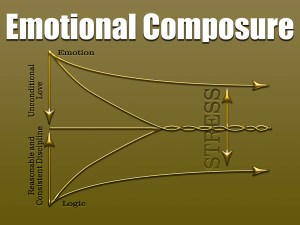
What is it? How does one acquire it? How does one maintain it? This diagram seeks to dissect those factors.
Look at the horizontal line. That’s the base line. You can think of it as a timeline between birth and the age 12. If you can think of it that way, birth will be back at the far left end of that horizontal line. There you see that birth emotion is very high and logic is very low.
A baby is born, emotionally high and logically low. In fact, the gap between the baseline and emotion is equal to the gap between the baseline and logic. To the extent that I am emotional (above the line) I will be illogical (below the line). We all have trouble thinking and feeling at the same time.
What a parent seeks to do is to bring the emotion down in a child. Parents do that through unconditional love. A lot of touch when the child is a baby, s/he doesn’t understand words, but begins to get the sense that s/he’s okay. That unconditional love brings the line down.
Logic is brought up in a child through reasonable and consistent discipline. Reasonable, meaning I don’t ask the seven-year old to mow the yard. Consistent means, if it’s bad on Monday, it’s bad on Wednesday, it’s bad on Friday. It builds in me a sense of stability and thinking. It teaches me to think consistently.
My logic is brought up. My emotion is brought down. So the ideal state, as you see on that horizontal line, is that the lines eventually inter-twine. Emotion inspires my logic. Logic controls my emotion. But to the extent that doesn’t get done, and my emotion swings out above the baseline to that same extent my logic is below the baseline and I experience stress.
You can go to the poster on Stress Management and see this same picture in a different perspective, it’s between what should be and what is. It’s stress. How do I bring the line down? Well, I have to continue to do what my parents didn’t get done. I have to learn to bring myself under the control of my own unconditional love — for me, for who I am, for who I have become. I have to discipline myself.
I believe everybody does discipline themselves. It’s just some people use better methods than others. We know that there are better methods to use on children to get better results.
The strongest method is affirmation. When I affirm a child and complement the child on what the child does right, it yields way more rewards than when I only point out what the child does wrong. What methods of disciplining are you using on yourself?
If you go to the website, davearch.com/innerdrive, you’ll find a workbook document there that you can download – speaking in the very back of it about all of the different ways you and I have to discipline ourselves.
As we begin using better methods of discipline on ourselves and treating ourselves with the unconditional love that we maybe didn’t receive as children, those lines can be brought closer together. Emotional Composure comes as a result. Emotional Composure–the ability to think clearly in the midst of an emotional situation–one of the hallmarks of a leader.
Categories: Emotional Composure
 Magic Club Leadership Resources