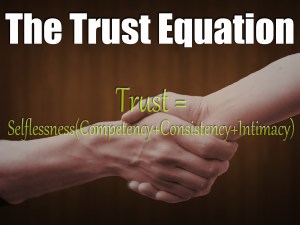
A leader cannot be a leader without the trust of his or her followers. The Trust Equation helps make trust (a rather abstract concept) very concrete by comparing it to a mathematical equation.
Before I can trust anyone, I must believe that the person is competent in their area of expertise. Next they have to be competent consistently. Then they have to be able to show me who they are through their intimacy skills. I have to be able to get to know them. I can’t trust an unknown quantity.
All of those together multiplied by selflessness. They’re not doing it for themselves. They put others’ best interest ahead of their own. Theirs is not a self-seeking motivation. If you look at that poster and you consider anyone of those missing, you can see the fracture that happens to trust. Trust gets diluted.
Now, will I ever trust someone without all of them? I suppose a very competent surgeon, for instance, I would trust them with my surgery even though they might not be particularly good in their bedside manner. But that’s very rare.
Trust, for most leaders, requires that their followers have a conviction about their competency, their consistency and has been able to establish a relationship with them. All of that multiplied by their selflessness. They put others’ best interests ahead of their own.
The intimacy component is the one that has been most challenging to define by those who I coach. Brene Brown to date has done the best job of breaking that down to its sub-points when she speaks about the intimacy component using the word BRAVING as an acrostic.
Boundaries – the ability to have and maintain personal boundaries and respect mine.
Reliability – carrying us back to the word consistency in the main equation.
Accountability – able to accept personal responsible and hold me responsible too.
Vault – maintain personal confidences.
Integrity – does what’s right instead of what’s expedient.
Non-Judgment – hears me without passing judgment on what I’m saying.
Generosity – gives me and others the benefit of the doubt when considering motives.
So, when you wonder why you don’t trust someone, you can come back to this poster.
When you wonder, as a leader, why others aren’t following you or giving you their trust, look no further than this equation. Something in the equation is missing or weak. In the final analysis, trust is nothing you can take from them. Your followers must give it to you as they discover you are trustworthy. The elements of “trustworthiness” are what this equation makes clear.
When they give you their trust or they don’t give you their trust, you can look at this formula and you can see where you’re weak and where you’re strong. That might be a great place to start right now. Where, in this formula, do you find yourself weak? Where do you find yourself strong?
And it’s not just in who you are, but it’s how you project yourself to others. It’s how others perceive you. Is the intent equaling the effect of what you want to have happened? The “Trust Equation” is a foundation for a leader.
The Trusted Advisor by David Maister is an excellent source of more information on this foundational subject.
Categories: Influence, Sociability
 Magic Club Leadership Resources